
Is your cat a good cat? Then buy today’s sponsor, a Big Ole Tub of Cat Treats for just $15!
Click Here to buy a Big Ole Tub of Cat Treats.
Amazon Affiliate Link
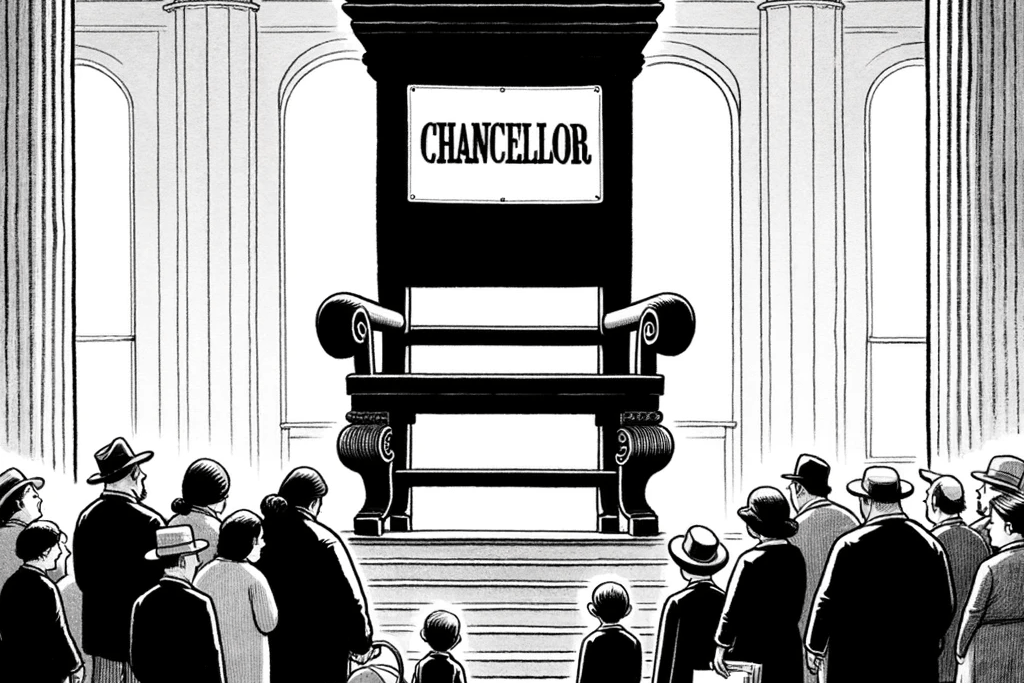
LONDON, February 19th, 1824 — The recent debate surrounding the Lord Chancellor and his Court has culminated in a development many had anticipated. The government conceded to the formation of a Commission to probe the Court’s inefficiencies, leading to the withdrawal of Mr. Williams’s motion. This move, albeit expected, underscores a recognition—acknowledged as far back as twelve years—of the urgent need for reform within the Court of Chancery. Such acknowledgment, however, has yet to translate into swift action, mirroring the sluggish pace of the Court it aims to expedite. The usual excuse of an overwhelming caseload hardly justifies or mitigates this inertia.
The incumbent Chancellor, far from being a mere spectator of the legal procession, wields considerable political and legislative influence. Given the significant benefits he has derived from his nation, one might argue that he owes it to his country to spearhead or at least champion some form of modest reform. Yet, has he initiated or even proposed any measures to streamline procedures or reduce costs? Our observations reaffirm that the Court of Chancery has been more detrimental to families and individuals than the notorious gambling dens, causing financial ruin and despair. It’s a system that has not spared even affluent households or charitable institutions from its clutches, diverting funds that could have been put to better use.
The proposition that Mr. Peel would oppose a Commission capable of casting aspersions on a figure who has allowed such systemic failures to persist is troubling. Yet, even more disconcerting is the suggestion of appointing a noble Lord to head this Commission, a notion that borders on the absurd and offensive. What efficacy can be expected from a body led by such a figure? This approach seems poised for failure, incapable of even feigning effectiveness to the public eye.
In a peculiar juxtaposition, the esteemed Sir William Grant’s name has been mentioned in conjunction with this endeavor, a move that baffles as much as it disconcerts, given his distinct departure from the characteristics of his supposed counterpart. The rationale behind merging such disparate figures for this task remains elusive. Moreover, the idea of entrusting the evaluation of reforms to individuals well into their seventies, including Sir William Grant who has long since retired, seems anachronistic. The anticipated outcome of their efforts, destined more for the annals of history than for practical application, underscores a profound disconnect with the pressing needs of the time.
In summary, while the establishment of a Commission to investigate the Court of Chancery’s failings marks a step towards acknowledging the need for reform, the manner in which it is being undertaken—coupled with the choice of personnel—casts doubt on its potential effectiveness. The legal community and the public at large await tangible improvements, not mere gestures toward change.
⁂
The content on this website is for entertainment purposes only.
Much of it has not been thoroughly reviewed by humans,
although we do get a blast from reading it ourselves.
But it should absolutely not be cited
as a source for anything other than itself.
We use OpenAI’s GPT-4 API to extract text
from the public-domain archive of The Times,
and rewrite this to contemporary standards.
Graphics are also largely AI-generated.
This website is supported by advertising and donations!
Please consider supporting today’s sponsor,
Big Ole Tub of Cat Treats by clicking here to learn more.
Please also consider making a donation here—
we get so excited every time we hear the bell ding,
and there’s no donation too small!




 The Long Ago Times
Leave a comment