
Dry skin? You already and know today’s sponsor: a big thank you to AVEENO Body Wash!
Right in that sweet spot of not-too-expensive and “it actually works!“
Amazon Affiliate Link
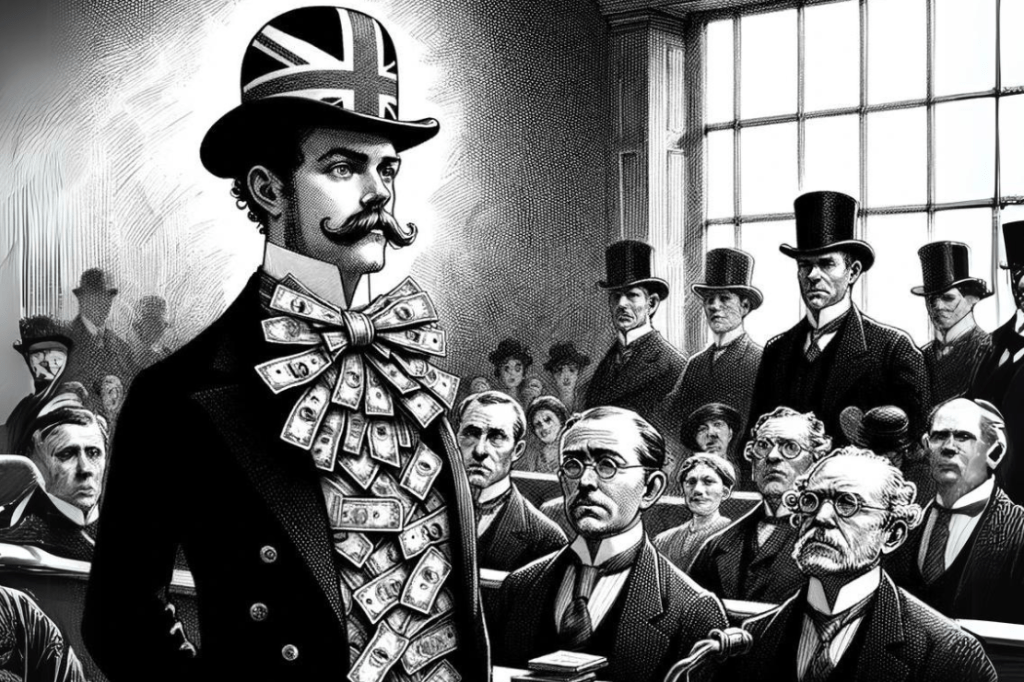
LONDON, February 20th, 1824 — In the hallowed halls of Parliament, a debate of considerable significance has unfolded, touching upon the venerable institution of the Bank of England and its intricate dance with public finance. At the heart of this discourse is a push towards an era where transparency and accountability are not just buzzwords but bedrocks of financial operations, particularly those as critical as the Bank’s stewardship of public money and its role in debt management.
The conversation was sparked by Mr. Grenfell, who initially aimed to shine a light on the Bank’s note issuance but pivoted towards a broader examination of its public duties, driven by an acute awareness of the Bank’s singular standing. This is a Bank that not only holds the nation’s purse strings but does so with privileges unrivaled by private entities. Grenfell’s restraint from probing into note issues stems from regulatory safeguards already in place, yet he remains steadfast in his call for annual disclosures on public deposits and the fees gleaned from managing the nation’s debt—a sum he deems overly generous given the Bank’s recent £260,000 haul.
The dialogue has since burgeoned into a multifaceted critique, encompassing the Bank’s lucrative interest on government balances—now notably diminished to £4 million—and the substantial fees it commands for public debt management. The chorus of voices, including that of Mr. Hume and Sir Henry Parnell, echoes a common theme: the imperative of disentangling government operations from Bank dependencies, a step seen as vital for both transparency and fiscal prudence.
Mr. Manning, representing the Bank, conveys a readiness to bare the institution’s books, a gesture towards openness that sets the stage for deeper scrutiny. Yet, it’s Mr. Ellice who brings a nuanced understanding to the fore, defending the Bank’s charges as fair, given the risks it shoulders, notably the specter of forgeries. He also refutes the notion that the Bank’s lending to landed gentry strays from its foundational principles, asserting instead that such activities are well within its chartered rights, an assertion that underscores the Bank’s role as a linchpin in times of agricultural distress.
The discourse doesn’t shy away from comparing the Bank of England with its Gallic counterpart, advocating for a level of transparency that reveals not just the volume of discounts and paper circulation, but also the profitability and bullion reserves—a transparency that could reshape perceptions of financial stability and the Bank’s role therein.
As the debate unfolds, it becomes clear that this is more than a fiscal inquisition; it is a critical examination of the Bank’s very ethos and operations. Critics, like Mr. Baring, caution against hasty moves to disrupt the Bank’s charter, highlighting the institution’s indispensability. Yet, they too acknowledge the need for a reassessment of practices, particularly the Bank’s penchant for loans on mortgage and its implications for future financial stability.
The dialogue culminates in a call for legislative and policy reforms that could redefine the Bank’s engagement with public finance, suggesting a future where the Bank, while still central to the nation’s economic fabric, operates with greater transparency and in closer alignment with the public interest.
As Parliament agrees on motions for financial disclosures and operational reforms, the debate marks a pivotal moment in the evolving relationship between the Bank of England and the British public. It heralds a potential shift towards a new financial epoch, where accountability and efficiency govern the management of public resources, setting a precedent that could influence banking institutions far beyond the British Isles.
⁂
The content on this website is for entertainment purposes only.
Much of it has not been thoroughly reviewed by humans,
although we do get a blast from reading it ourselves.
But it should absolutely not be cited
as a source for anything other than itself.
We use OpenAI’s GPT-4 API to extract text
from the public-domain archive of The Times,
and rewrite this to contemporary standards.
Graphics are also largely AI-generated.
This website is supported by advertising and donations!
Please consider supporting today’s sponsor,
AVEENO Body Wash, by clicking here to learn more.
Please also consider making a donation here—
we get so excited every time we hear the bell ding,
and there’s no donation too small!


 The Long Ago Times
Leave a comment