
Have you ever cracked your iPhone screen? It sucks, right? Don’t let it happen again! 👺
Instead, buy today’s sponsor, $6 iPhone screen protector!
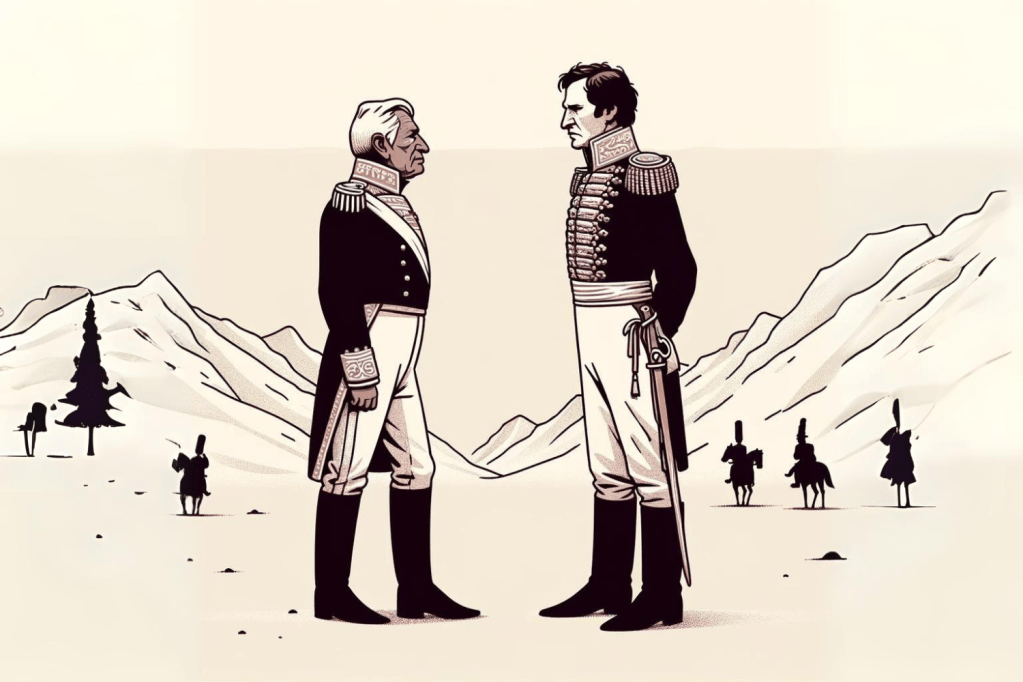
LIMA, October 1st, 1823 — In the latest dispatches from Lima, obtained via the Lima Gazette dated October 1, unfolds a drama of defiance and military strategy. At the heart of the narrative is the ex-President of Peru, Don José de la Riva Aguero, whose steadfast refusal to accept reconciliation offers from the current government, mediated by none other than the storied Liberator, Simon Bolivar, signals a deepening crisis. Aguero’s recalcitrance, viewed as a direct affront to Bolivar’s authority and a catalyst for anarchy, has compelled the Peruvian constituent Congress to empower Bolivar with supreme authority to quell this rebellion by any means deemed necessary.
This decree, endorsed by the highest echelons of Peruvian governance—signatories President of the Congress Jose Bernardo and President of the Republic Tagle—underscores a decisive shift towards military resolution after diplomatic efforts falter. It speaks to a broader context of a nation grappling not only with internal dissent but also the specter of colonial reassertion, as evidenced by subsequent decrees aimed at bolstering military ranks depleted by desertion. In a candid admission of the challenges faced, the government has instituted a carrot-and-stick approach to deserters, offering clemency to those who rejoin the ranks, while threatening the severest penalties for those who shirk their duties, and those providing them sanctuary.
Parallel to this internal strife, a dispatch from General Santa Cruz from Sopita, in Arequipa, dated August 26, heralds a significant victory against Spanish forces under General Valdez. This triumph is not just a tactical win but symbolizes the liberation of vast territories from Spanish dominion, dealing a critical blow to the colonial supply chain. Santa Cruz’s account of the battle, marked by strategic retreats and decisive counterattacks, showcases the intricate dance of 19th-century warfare, where victory hinges on a blend of valor, strategy, and the element of surprise.
Santa Cruz’s victory narrative, replete with details of troop movements, battlefield positions, and the spoils of war, encapsulates the spirit of a continent in the throes of self-determination. It’s a testament to the complex interplay of military prowess, political will, and the unyielding quest for sovereignty that defines this era of Latin American history. As Peru confronts the dual threats of internal division and external subjugation, these dispatches offer a window into the tumultuous journey towards nationhood.
⁂
The content on this website is for entertainment purposes only.
Much of it has not been thoroughly reviewed by humans,
although we do get a blast from reading it ourselves.
But it should absolutely not be cited
as a source for anything other than itself.
We use OpenAI’s GPT-4 API to extract text
from the public-domain archive of The Times,
and rewrite this to contemporary standards.
Graphics are also largely AI-generated.
This website is supported by advertising and donations!
Please consider supporting today’s sponsor,
$6 iPhone Screen Protector, by clicking here to learn more.
Please also consider making a donation here—
we get so excited every time we hear the bell ding,
and there’s no donation too small!

 The Long Ago Times
Leave a comment