
Crocs! Are they back in style? Or did they never go away?
Either way, they’re today’s sponsor! Crocs!
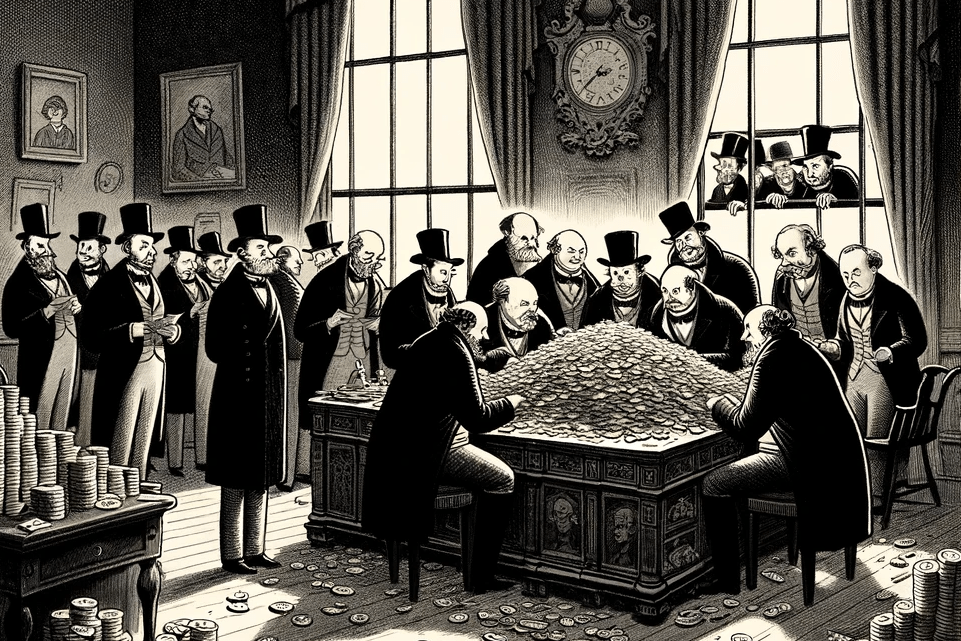
LONDON, February 13th, 1824 — An anonymous correspondent calling himself “Tuebor” critiques recent government appointments, hinting at further revelations to come. This letter underscores concerns over the appointment of Mr. Vincent to a role that, despite recommendations from two parliamentary committees advocating its discontinuation, remains active. This scenario prompts a reflection on the potential erosion of the House of Commons’ dignity, likened to the reckless consumption of resources from both ends. The public’s growing disillusionment with the House as an effective representative body is matched only by the government’s dismissive attitude towards the House’s directives, challenging the very utility of forming committees aimed at national budget efficiency.
This disregard for parliamentary committees, often formed not to challenge but to align with governmental preferences, raises questions about the effectiveness of such bodies. Even when these committees are dominated by government loyalists, their moderate and cautiously crafted resolutions are seemingly overridden by arbitrary decisions or undisclosed commitments by political leaders. This phenomenon reflects poorly on the integrity of governmental processes and the House’s oversight role.
Further exacerbating concerns is the government’s apparent indifference towards fiscal prudence and fairness, as highlighted by the appointment of Mr. Vincent to the King’s Remembrancer office—a move that sparked the original critique. Beyond this case, the author warns of a broader pattern of corruption, particularly within the Treasury, where clerks are allegedly fast-tracked to lucrative positions at the expense of deserving public servants. This practice, perceived as a strategy to bolster governmental influence, undermines the meritocratic principles that should guide public service appointments.
The writer appeals to the public and parliamentary members to counteract these unjust practices, suggesting that the legislative body has a paramount duty to curb the government’s unchecked expansion of influence. With a call to action, “Tuebor” urges for a collective effort to safeguard public service integrity against the encroachments of corruption, emphasizing the critical role of informed and vigilant oversight in preserving democratic values and governance efficacy.
As we digest these assertions, the narrative not only sheds light on the challenges of maintaining governmental accountability but also invites a broader discourse on the mechanisms of power and influence within the public sector. It’s a call for introspection on the part of both the government and the governed, to ensure that the principles of justice, efficiency, and representation remain at the forefront of public service.
⁂
The content on this website is for entertainment purposes only.
Much of it has not been thoroughly reviewed by humans,
although we do get a blast from reading it ourselves.
But it should absolutely not be cited
as a source for anything other than itself.
We use OpenAI’s GPT-4 API to extract text
from the public-domain archive of The Times,
and rewrite this to contemporary standards.
Graphics are also largely AI-generated.
This website is supported by advertising and donations!
Please consider supporting today’s sponsor,
Crocs, by clicking here to learn more.
Please also consider making a donation here—
we get so excited every time we hear the bell ding,
and there’s no donation too small!



 The Long Ago Times
Leave a comment