
Are you still making ice cubes in an ice cube tray? Can you honestly answer us why? Technology solved this problem so long ago!
Try today’s sponsor, a Tabletop Ice Cube Maker!
LONDON, February 12th, 1824 —
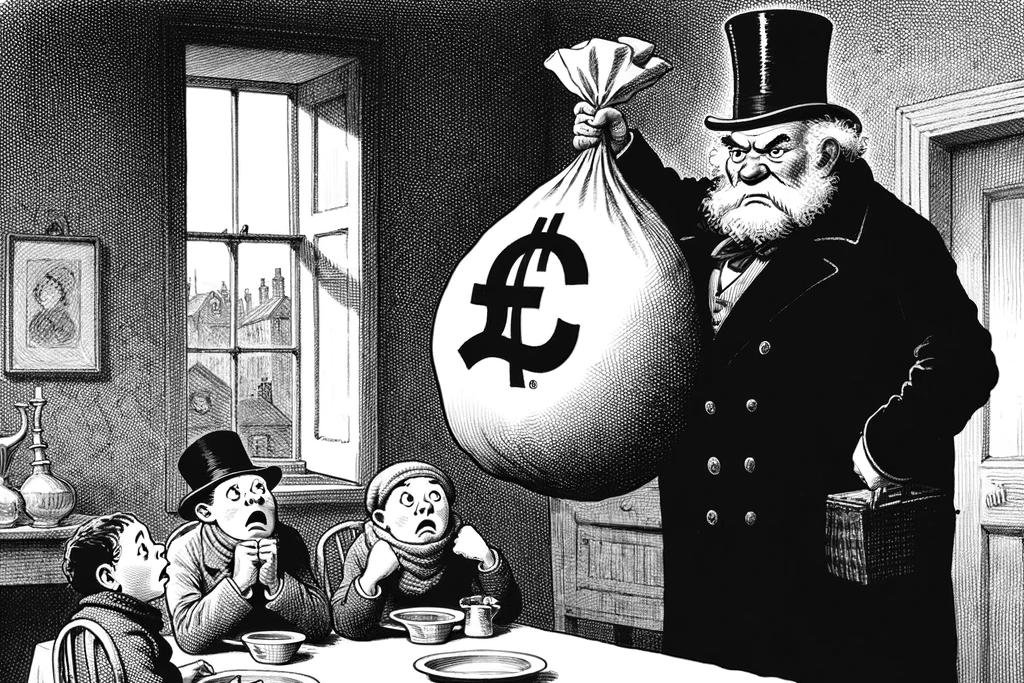
In a spirited session of the House of Commons last evening, the debate surrounding the Legacy Duty—a subject of considerable consternation—was reignited with vigor. The motion, led by the indefatigable Mr. Hume for the release of pertinent documents, has cast a spotlight once again on a tax regime that, in the eyes of many, embodies the zenith of fiscal intrusiveness.
It is the fervent hope of this publication that the government will heed the growing chorus of disapproval and consign this tax to history. At its core, the Legacy Duty represents an affront to the principle of property rights, penalizing beneficiaries at the moment of inheritance—a juncture when the assets in question have yet to be employed towards any productive endeavour.
This tax, by its very design, is flawed, targeting the embryonic stage of wealth distribution. Such an approach not only stifles the initial impulses of industry but also precludes the state from sharing in the eventual fruits of economic growth. Were legatees allowed unfettered access to their bequests, such wealth would not escape the taxman’s grasp. Rather, it would remain within the economic circulatory system, actively contributing to the exchequer through various forms of productive engagement.
The argument often levied in defense of the Legacy Duty, citing its yield of one to two million pounds, fails to account for the broader economic detriment it inflicts. These millions, extracted at the expense of personal initiative and industry, are diverted away from the productive economy and sequestered within the state’s coffers, representing a significant opportunity cost.
Thus, as we look towards a more enlightened fiscal policy, it is imperative that the Legacy Duty be abolished. Its existence serves as a stark reminder of the delicate balance between taxation for public good and the undue encroachment upon personal wealth and liberty.
⁂
The content on this website is for entertainment purposes only.
Much of it has not been thoroughly reviewed by humans,
although we do get a blast from reading it ourselves.
But it should absolutely not be cited
as a source for anything other than itself.
We use OpenAI’s GPT-4 API to extract text
from the public-domain archive of The Times,
and rewrite this to contemporary standards.
Graphics are also largely AI-generated.
This website is supported by advertising and donations!
Please consider supporting today’s sponsor,
Tabletop Ice Cube Maker by clicking here to learn more.
Please also consider making a donation here—
we get so excited every time we hear the bell ding,
and there’s no donation too small!


 The Long Ago Times
Leave a comment