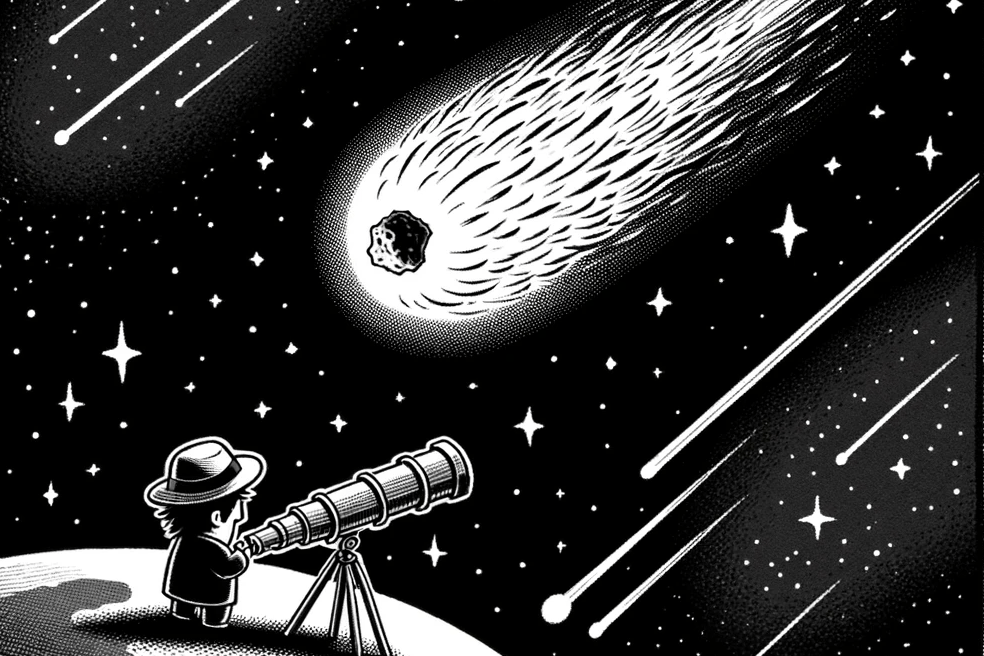
LONDON, February 5, 1824 — In recent weeks, the astronomical community has been closely monitoring a comet whose behavior has been notably unusual compared to typical patterns observed in these celestial wanderers. Initially spotted approximately a month ago, the comet’s trajectory seemed to take a northerly course, with minimal deviation in its right ascension—leading experts to speculate it might become a circumpolar object, remaining perpetually above the northern horizon for observers.
However, in a surprising twist, the comet reversed its path over the last week, embarking on a retrograde motion. It achieved a remarkable shift of ten degrees in right ascension within a mere 24-hour period, while also moving southward. This unexpected movement suggests that the comet has drawn closer to Earth, despite a decrease in its orbital speed. Paradoxically, its increased distance from the sun during this phase has dimmed its visibility from our vantage point.
Tonight, the comet is anticipated to align nearly opposite the sun in terms of right ascension, making its highest passage across the meridian around midnight. In this position, its tail, extending away from Earth, will likely manifest as a halo or coma encircling the nucleus, offering a unique spectacle for observers.
The Royal Observatory has been diligently recording observations of this comet, laying the groundwork for precise calculations of its orbital elements. Dr. Brinkley, a prominent figure in the field, has already shared preliminary findings based on his meticulous studies, offering a provisional insight into the comet’s trajectory and potential impact on its orbit due to its proximity to Earth. These recent observations are crucial for understanding whether this close encounter has altered the comet’s orbit, presenting an extraordinary case study of its interaction with our planet. As reported in an evening publication, the scientific community awaits further analysis with keen interest.
⁂
The content on this website is for entertainment purposes only.
Much of it has not been thoroughly reviewed by humans,
although we do get a blast from reading it ourselves.
But it should absolutely not be cited
as a source for anything other than itself.
We use OpenAI’s GPT-4 API to extract text
from the public-domain archive of The Times,
and rewrite this to contemporary standards.
Graphics are also largely AI-generated.
This website is supported by advertising and donations!
Please consider supporting our sponsors
by clicking the affiliate link on today’s lead article.
Please also consider making a donation here—
we get so excited every time we hear the bell ding,
and there’s no donation too small!







 The Long Ago Times
Leave a comment