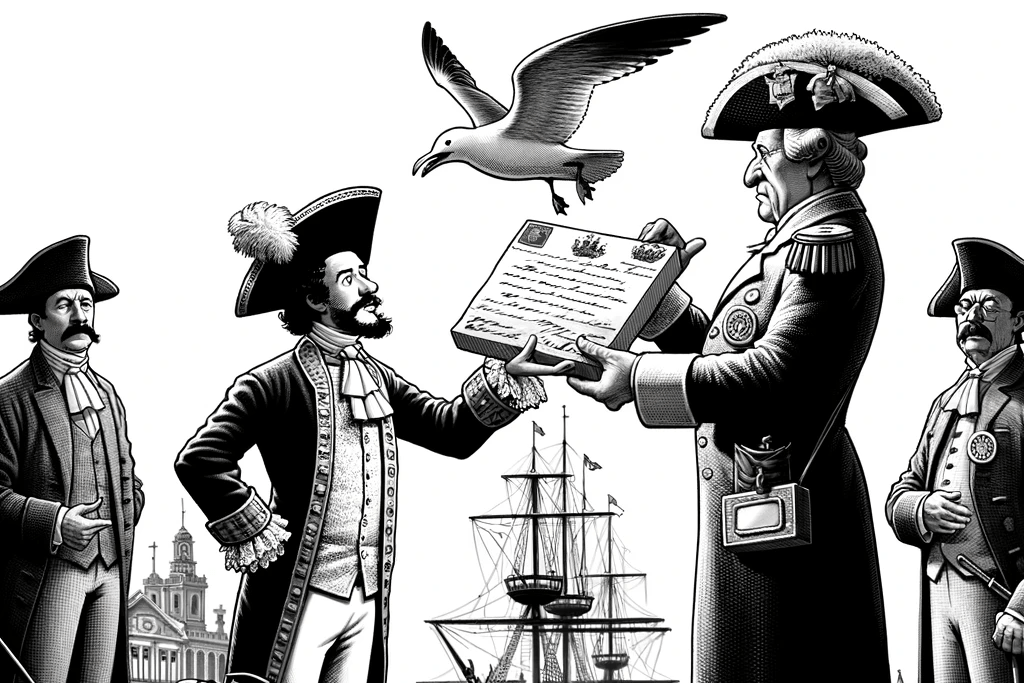
BAHIA, July 30, 1823 — In the aftermath of the dissolution of the Constitutional system in Portugal, King John VI has made a significant move towards reconciliation with Brazil, sending heartfelt letters to his son and heir, Prince Dom Pedro de Alcantara, as well as to his daughter-in-law, the Princess Royal. These letters, written by the King himself, emphasize the urgent need to mend the rift that has divided the two kingdoms and caused harm to their people.
King John VI’s correspondence, however, faced a considerable obstacle as it was returned unopened by the Brazilian Government, which refused to allow the letters to be landed. The King’s message, nonetheless, conveys a sincere desire to restore harmony between Portugal and Brazil.
In the letter addressed to his son, Prince Dom Pedro, King John VI expresses his longing for unity between the two realms and discusses the recent events in Portugal that have led to the reestablishment of the monarchy. He calls for an immediate end to hostilities in Bahia and assures his son that he has removed all hindrances to communication between the two kingdoms. The King also highlights his commitment to preserving Brazil’s trade privileges and emphasizes his hope that Prince Dom Pedro will contribute to the reestablishment of relations between the Portuguese in both hemispheres.
The letter to his daughter-in-law, the Princess Royal, conveys the King’s esteem and regret for their separation. He mentions his physical discomfort in his legs but assures her that the rest of the Royal Family is in good health. King John VI closes the letter with warm wishes for her and her family’s well-being.
These letters, bearing the date of July 23, 1823, underscore the King’s determination to mend the divisions and strengthen the ties between Portugal and Brazil, even as political tensions persist. The rejection of the letters by the Brazilian Government reflects the ongoing challenges in achieving reconciliation between the two nations.
⁂
The content on this website is for entertainment purposes only.
Much of it has not been thoroughly reviewed by humans,
although we do get a blast from reading it ourselves.
But it should absolutely not be cited
as a source for anything other than itself.
We use OpenAI’s GPT-4 API to extract text
from the public-domain archive of The Times,
and rewrite this to contemporary standards.
Graphics are also largely AI-generated.
This website is supported by advertising and donations!
Please consider supporting our sponsors
by clicking the affiliate link on today’s lead article.
Please also consider making a donation here—
we get so excited every time we hear the bell ding,
and there’s no donation too small!


 The Long Ago Times
Leave a comment