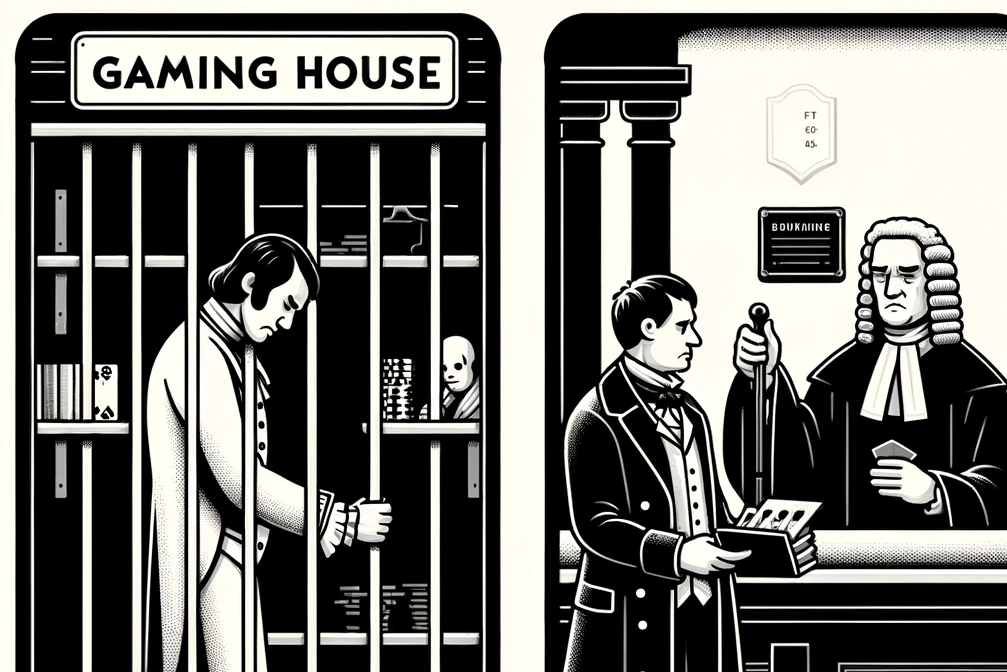
LONDON, February 5th, 1824 — In a recent judgment that has captured the attention of legal circles, the Court of King’s Bench in Westminster handed down decisions in two high-profile cases, underscoring the complexities and moral quandaries surrounding gaming houses and the integrity within the insurance sector.
In the case of The King v. Fielder, the court was asked to pronounce judgment on a defendant convicted seven years prior for operating a common gaming house. The Attorney-General sought to finally address the defendant’s fate, who, through medical affidavits, claimed deteriorated health necessitating frequent outdoor activity. Further affidavits, including one from the defendant himself, asserted a cessation of all gaming activities for the past two years, underscoring a claimed reformation of character.
Counsel for the defense, Mr. Adolphus, in a plea for leniency, highlighted the dated nature of the prosecution and the absence of any aggravating factors such as unfair play or attempts to entice the unwary. He emphasized the defendant’s efforts to maintain a degree of integrity within the confines of the accused activities. Despite these arguments, the prosecution maintained that the defendant had engaged in a calculated delay of justice, continuing his illicit operations well after the initial conviction.
Ultimately, the court sentenced the defendant to a month in Newgate prison, fined him £3,000, and required securities for good behavior over five years, signaling a stern stance against gaming-related misconduct while acknowledging the time elapsed since the initial offence.
In a separate but equally intriguing case, The King v. Thomas Bignold, Sen., the court addressed allegations of perjury against the founder of an insurance society modeled after the Norwich Union. The indictment stemmed from a Chancery suit seeking an account of funds, wherein Bignold was accused of falsely denying an agreement to invest £10,000 on behalf of the institution. Despite his defense claiming a misunderstanding over the nature of his commitment, the court found Bignold guilty.
The case took a procedural twist as Bignold sought a retrial or judgment arrest, arguing that the alleged perjury was immaterial to the suit’s outcome and citing his attorney’s refusal to release crucial documents without payment. The court’s decision to review the matter further underscores the intricate balance between legal technicalities and the pursuit of justice.
These cases, reflective of broader societal issues around gambling and financial integrity, exemplify the legal system’s ongoing struggle to adjudicate complex matters of law and morality. As these judgments reverberate through the halls of justice, they prompt a deeper contemplation of the legal frameworks governing gaming and financial practices, and the importance of transparency and integrity within these sectors.
⁂
The content on this website is for entertainment purposes only.
Much of it has not been thoroughly reviewed by humans,
although we do get a blast from reading it ourselves.
But it should absolutely not be cited
as a source for anything other than itself.
We use OpenAI’s GPT-4 API to extract text
from the public-domain archive of The Times,
and rewrite this to contemporary standards.
Graphics are also largely AI-generated.
This website is supported by advertising and donations!
Please consider supporting our sponsors
by clicking the affiliate link on today’s lead article.
Please also consider making a donation here—
we get so excited every time we hear the bell ding,
and there’s no donation too small!




 The Long Ago Times
Leave a comment