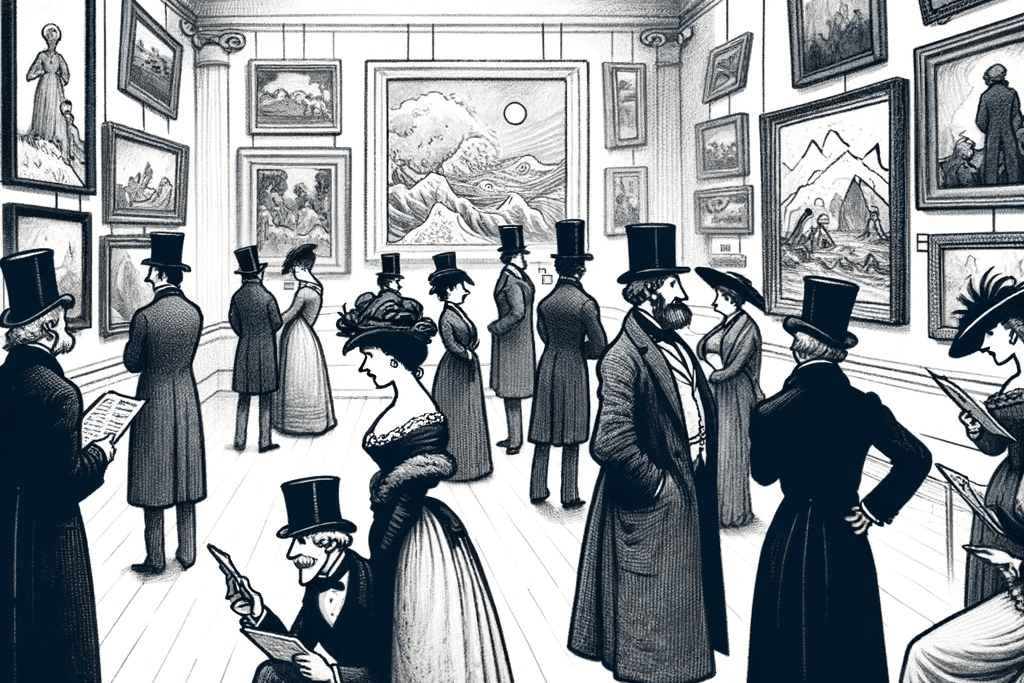
LONDON, February 5, 1824 — In a recent private viewing at the British Institution in Pall Mall, now open to the public, this year’s exhibition of modern pictures presented a mixed bag of artworks. Contrary to previous years, the current collection seems to lack the usual abundance of high-caliber pieces, raising questions about the selection process and the artists’ willingness to showcase their work in this venue.
Central to the exhibition’s appeal, however, are the works of Eastlake, which continue to captivate audiences with their novel subject matter and an undeniable sense of realism and earnestness. Despite this, Eastlake’s progression, particularly in the realm of color, appears to have stalled since last year, suggesting a potential creative plateau.
Among the standout pieces is Eastlake’s “The Bandit of the Apennines” (No. 304), notable for its compelling narrative. Similarly, Etty’s “Maternal Affection” (No. 341) emerges as a gem, with its exquisite expression of tenderness and pure color palette. Etty’s mastery of Venetian coloring techniques is evident, a skill that will undoubtedly garner greater appreciation over time.
Howard’s “Iris and her Train” (No. 23) exemplifies the artist’s penchant for elegance and grace, though its personification aspects could be clearer. Hilton’s “Comus and the Lady in the Enchanted Chair,” previously shown at Somerset House, makes a reappearance, its pleasing aesthetics marred slightly by a lack of attention to key elements.
H.P. Briggs contributes notably with his depiction of Colonel Blood’s attempt to steal the Regalia (No. 121), a work that solidifies his esteemed reputation. The portrayal of Blood and the Keeper brims with life, though the piece could have benefited from a bit more intensity in certain characters.
The exhibition also marks the return of Owen, whose recent indisposition has been a cause for concern. His “Study of a Head” (No. 160) is not only a testament to his enduring skill but also a hopeful sign of his imminent recovery.
Other noteworthy contributions include Linton’s landscapes, the Foggos’ historical piece, Fradelle’s charming cabinet piece, and Landseer’s “The Cat’s Paw.” C.R. Stanley’s handling of perspective in his work (No. 110) is particularly commendable.
In sum, while this year’s exhibition at the British Institution may not rank among its most illustrious, it still offers a plethora of works that showcase the diverse talents and styles of the period’s artists, each contributing to the rich tapestry of modern art.


 The Long Ago Times
Leave a comment